

NEW: MY INTERVIEWS for „MUSIC WEEKLY“ and „NATIONAL CENTRE FOR THE PERFORMING ARTS“ in BEIJING 2026 Überschrift
Sometimes, you work and made gifts to potentially interested (and potentially younger) colleagues
and even if you don’t do that expecting that people would say thank you, it is a bit demoralising if no feedback comes. In my age you can think and accept this telling yourself “I am doing it for myself and my own mental health”, which is definitively true. But when, even seldom, somebody from your own homeland call you “a living legend of early music in Croatia” it is paying off hours, days, months and years of working. And then, one day you are contacted by young specialist who for certain period follows your activities and appreciate it.
This was the case of Chinese musicologist and baroque violinist, Dr. Jie Gao (visiting Professor at East Asian Studies Institute, The University of Memphis) who contacted me and ask me for two interviews, a shorter one for “Magazine of the National Centre for the Performing Arts” in Beijing and the longer one for Music Weekly newspaper, also in Beijing. This second one was published on March 4th.
I was deeply impressed how good Jie understand not only my activities but also ideas behind them which motivated this work. I am bringing here her interview in its original form and an AI translation in English, one of three closest to my answers…
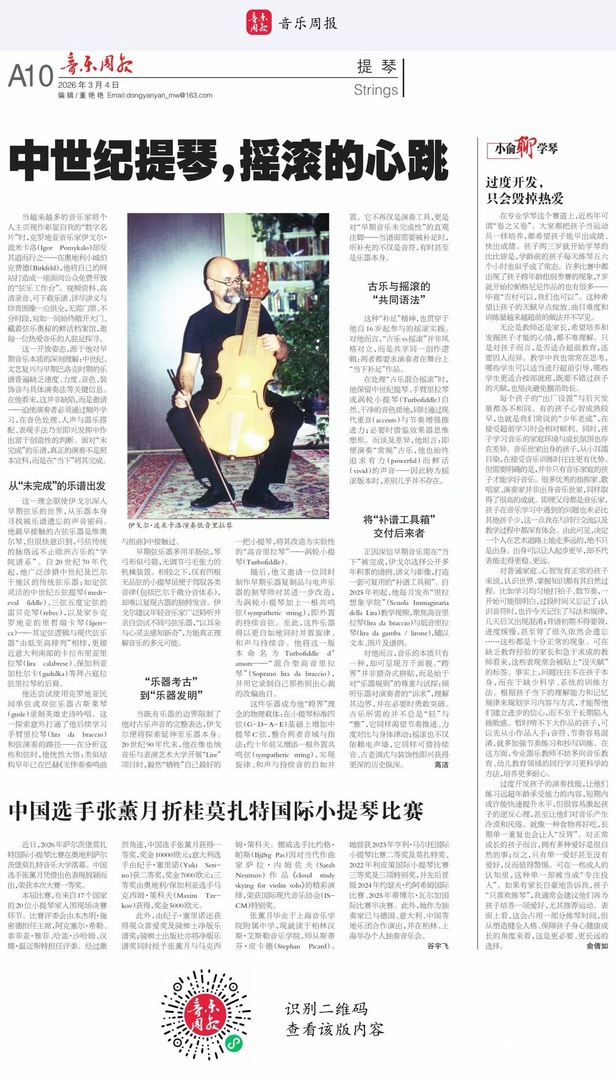
Medieval Fiddle, the heartbeat of rock and roll
While more and more musicians regard their personal websites as "digital business cards" to showcase themselves, Croatian musician Igor Pomykalo has taken a different approach—in the small Austrian town of Birkfeld, he has transformed his website into a "string workbench" open to the public free of charge. It offers a wealth of video materials, high-definition recordings, downloadable sheet music, detailed lecture notes, and precious images, all available without tickets or time restrictions. Like a vibrant archive, always open to the public and holding the secrets of string music, it invites every music lover to stop and explore.
This open-minded approach stems from his profound understanding of the essence of early music: scores from the Middle Ages, Renaissance, and early Baroque periods generally lacked crucial information such as tempo, dynamics, timbre, ornamentation, and specific performance techniques. In his view, this was not a deficiency, but an invitation—forcing performers to make creative judgments on timbre treatment, vocal and instrumental pairings, expressive techniques, and even improvisation through additional learning. Faced with an "unfinished" score, true performance is not about rote memorization, but about completing it "in the present moment."
Starting from the "unfinished" score
This idea drove Igor to delve into the world of early string music, searching for the sonic codes forgotten in the scores from the instruments themselves. The first ancient stringed instrument he encountered was the viol, but he quickly realized that the lineage of bowed string traditions extended far beyond the "academic lineage" of early European music. Since the 1970s, he has extensively explored traditional stringed instruments from the Middle Ages and the Balkans: such as the flexible medieval five-stringed fiddle, the rebec with its three strings tuned to fifths, and the lijerica from his native Croatia—whose tuning logic contradicts the modern stringed instrument "low to high" arrangement, and is closer to the descendants of the Byzantine bowed lira, such as the Calabrian lira from southern Italy and the Gadulka from Bulgaria.
He also experimented with recording heroic epic chants on the Croatian folk single- or double-stringed instrument, the gusle. This exploration unexpectedly paved the way for his later study of lira da braccio chord playing—while analyzing these chords, he realized that similar structures had been seen in Bach's *Sonata for Violin Solo*.
Early stringed instruments mostly used gut strings, and their bows were shaped like arrows, lacking mechanical mechanisms for adjusting bow hair tension. In contrast, while the violin, with its four fretless strings, is easier to play in various scales (including the Balkan microtone system), it struggles to reproduce the unique sound of these ancient instruments. Igor advises young musicians to listen widely and try different bowed string instruments themselves, "to perceive the novelty with their ears and hearts," in order to truly understand the diverse possibilities of music.
From "Archaeology of Musical Instruments" to "Invention of Musical Instruments"
When the limitations imposed by existing instruments restricted his complete expression of early music sounds, Igor extended his exploration to the instruments themselves. In the late 1990s, while conducting the "Lire" project at the University of Music and Performing Arts Vienna, he resolutely "sacrificed" his best violin…
A violin was transformed into an experimental "high-pitched lyre"/ Soprano Lira da braccio—the Turbofiddle. This instrument became the physical embodiment of his "crossover" concept: adding a viola C string to the standard four-string violin (G-D-A-E) to integrate their ranges and fingerings.
Ten years ago, he invited a luthier who made replicas of early instruments as well as electronic instruments to further modify it, adding a sympathetic string to the Turbofiddle. This allowed the instrument to more freely juxtapose melody, harmony, and sustained notes simultaneously. He named this version the Turbofiddle d'amore—"Soprano lira da braccio"—and used it to record his own unique and ingenious works and arrangements.
It is no longer just a playing tool, but also a direct footnote to the "incompleteness of early music"—when the score needs to be supplemented, what is supplemented is not only the notes, but sometimes even the instrument itself.
The "Shared Grammar" of Early Music and Rock
This spirit of "completion" also runs through his rock practice since he was 16. For him, "early music vs. rock" is not a stylistic opposition, but rather a sharing of the same creative logic: both require performers to "complete" the work on stage in the present moment.
When working with "early music mixed with rock," he retains the natural, clean tonal texture of medieval fiddle, lira da braccio, or Turbofiddle, while enhancing the driving force through modern accents and rhythms; he also incorporates effects thinking to shape the sound when necessary. Regarding the differences, he frankly admits that even when playing "conventional" early music, he always strives for a powerful and vivid sound—therefore, when transitioning to rock versions, the differences are almost nonexistent.
Passing on the "score completion toolbox" to successors
Because he firmly believes that early music needs to be completed "in the present moment," Igor chose to make public his years of accumulated scores, lecture notes, and videos, creating a reusable "score completion toolbox." Since the beginning of 2025, he has been releasing bi-monthly "Scuola Immaginaria della Lira" teaching videos, focusing on the soprano lyre (lira da braccio) and bass lyre (lira da gamba / lirone), supplemented with text, images, and scores.
For him, music has only one essence, yet it can present countless facets. "Crossover" is not a novelty-seeking collage, but rather begins with respect for and exploration of the "rules of the instrument": listening to the instrument's "demands" from the performer, understanding its boundaries, and bravely breaking through them when necessary. Early music doesn't always require "lightness" and "elegance"; it also craves rhythmic progression, dynamic contrast, and physical movement. Rock music doesn't solely rely on electric walls; it can also gain deeper historical depth through sustained tones, ancient modes, and decorative improvisation.
(Gao Jie)
 Druckversion