

MAGAZINE OF THE “NATIONAL CENTRE FOR THE PERFORMING ARTS”, BEIJING
A Guide to Multi-Instrument Mastery, By Gao Jie
Many of the musical giants we know are not only renowned for their mastery of a single instrument, but also proficient in playing other instruments. For example, Johann Sebastian Bach, the universally acknowledged great composer, was not only a famous organist but also an outstanding harpsichordist. Furthermore, he was adept at playing the violin, cello, oboe, bassoon, French horn, and recorder. It is said that Bach could also play many Baroque instruments rarely seen in orchestras today. Then there's the musical genius Mozart, who could play the organ, piano, harpsichord, violin, and viola; the musical saint Beethoven, a master pianist, also studied the organ and violin…
Today, contemporary musicians also continue this tradition of multi-instrument playing. On video platforms, one can see musical works of this kind recorded and edited by musicians. For example, violinist Ning Feng recorded a Mendelssohn Octet while playing the violin, viola, and cello; Italian-German violinist Augustin Heidrick uploaded a video of himself playing the violin and accompanying himself on the piano; and Niu Jiandang, a suona soloist with the China National Traditional Orchestra, performed and explained various folk wind instruments during the recording of a public welfare music course.
The "Cross-Border Dialects" of the Musical World
Ning Feng believes that "some instruments are very similar, while others are quite different." Heidrick states, "I think learning different instruments is like learning different alphabets and writing systems in a language." Niu Jiandang shares a similar view: "Except for the saxophone, all the instruments I play are Chinese folk instruments. The musical vocabulary is the same, and the musical expression is very national and traditional. The differences between instruments, besides technique, also lie in musical style. For example, there are similarities between improvisation in Chinese folk music and improvisation in jazz."
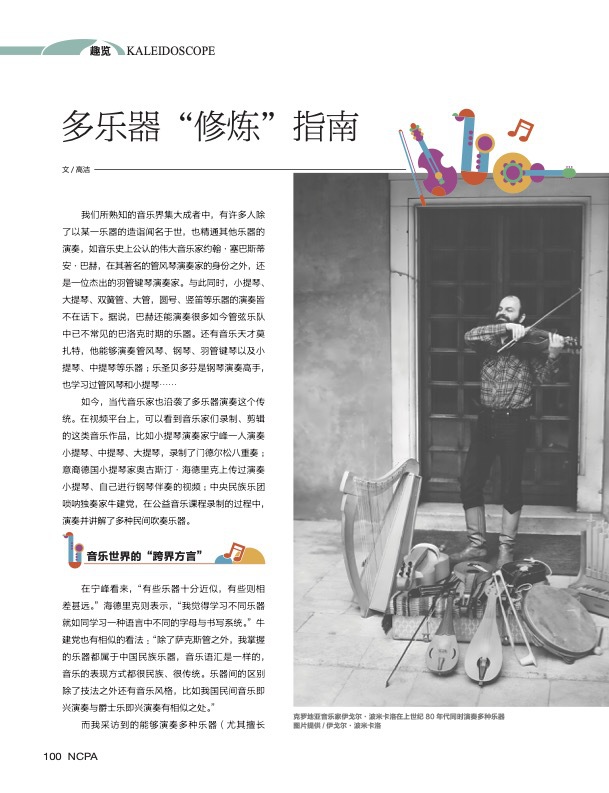
And Igor Pomykalo, a Croatian musician I interviewed who can play multiple instruments (especially excelling in...), also believes there are similarities between learning multiple instruments and learning a language. He said, "You can compare it to learning a language; learning your first language after your mother tongue is more difficult, but subsequent language learning happens more naturally." Mr. Igor was born into a musical family; his mother was a renowned singer and vocal educator, and his father was a conductor, composer, and violin and trumpet player. His two uncles were also multi-instrumentalists, one playing the trombone and cello, and the other the clarinet and viola. Igor initially studied violin and piano, later choosing the viola as his major. He continued his family's crossover musical tradition—not only playing jazz like his father, but also founding his own rock band "Pirati" (later renamed "Uskoci"). Since 1969, when he began exploring early music, he has mostly learned many instruments from that period through self-study. /…/
Specializing in one instrument or playing a wide range of instruments?
Igor believes that it is difficult for one person to become a master of many instruments. He chose the viola as his main instrument, but emphasized that the ability to play multiple instruments is particularly important for the study and interpretation of early music. Because orchestration at that time lacked a fixed paradigm, historical records indicate that almost all professional musicians were multi-talented—singers and multi-instrument players, proficient in bowed string, wind, and plucked instruments.
Igor himself started by playing modern instruments and recording imitations of early music, gradually transitioning to Baroque instruments and even the viola da gamba. He said, "Gut strings and different types of bows further compel performers to change their playing techniques and performance styles." It was precisely his mastery of various early instruments that allowed him to navigate the free and flexible world of early music orchestration with ease./…/
Mutual Influence or Complementary Strength?
Igor, gained a comprehensive historical perspective and flexible musical thinking from playing multiple instruments. The interaction between different instruments in his hands further deepened his understanding of the essence of music. He proactively shares his recordings, sheet music versions, and research materials on his personal website, driven by two motivations: first, gratitude for the invaluable help he received early in his musical career; and second, a desire to share his rich experience with younger colleagues. This sharing, in turn, nourishes his artistic life after retirement: maintaining his curiosity about music and experiencing the process of his work being appreciated (especially by young people) brings him immense satisfaction. /…/
Multi-instrument exploration also begins with interest.
According to Niu Jiandang, "If it's a hobby, there's no time limit for learning a new instrument. If you want to pursue professional performance, the earlier you start at the appropriate age, the better.”/…/
Just as Igor's precious photographs record—his studio in Zagreb in 1982 with various instruments, his collaboration with musicians in Austria in 1996, his performances of medieval and Renaissance music throughout Croatia in 2002, and his immersion in playing the lijerica until 2019—time flows, but the dialogue between musicians and their instruments remains ever vibrant.
Chief Editor / Kong De Graphic Designer / Gao Xue
 Druckversion